The AI Reliability Gap: Gunasai Muppala on Validation, Security and Human Judgment at Scale.
By Zachary Rodriguez-Lopez·2026-10-28

The Reliability Gap at Scale
The AI reliability gap describes a growing mismatch: modern models can generate recommendations and actions at extraordinary speed, but organizations still need robust methods for validating those outputs, measuring outcomes, detecting failures, securing systems, and preserving meaningful human accountability. That distinction is not a narrow academic point. It becomes a practical problem whenever an automated recommendation begins influencing a consequential decision.
A Career That Followed the Question
Gunasai Muppala traces his interest in the reliability gap to a combination of education and experience across several operational environments. He began with Computer Science studies in India and later completed a Master’s in Business Analytics at Arizona State University. That transition introduced a focus not only on whether a system could produce an output, but on whether that output actually improved a real decision, how such improvement could be demonstrated, and what safeguards were necessary when the consequences mattered.
At Better Being Co., formerly Nutraceutical, Muppala worked on business intelligence, analytics, reporting, automation, and operational decision support. Better Being's brands are distributed in more than 65 countries, which illustrated the broad operating environments in which analytics and decision-support processes may need to function consistently. The experience reinforced an early lesson: dashboards and automation are useful only when paired with appropriate metrics and people capable of interpreting what those metrics actually mean.
At Meta, he moved into product analytics and product operations for commerce experiences across Facebook and Instagram. That environment sharpened his attention to experimentation. At scale, even small product or operational changes can produce significant effects, so teams need carefully defined success criteria, appropriate experimental methods, and mechanisms for detecting unintended outcomes. Meta reports roughly 3.6 billion daily active people across its family of apps, illustrating the scale at which modern digital systems can operate.
Muppala’s work involving Discover and Capital One brought those questions into financial services. His analytical experience touched consumer remediation, acquisition, experimentation, fraud, and risk—areas where analytical errors can have clear consequences for consumers. Capital One says it serves more than 100 million customers, underscoring why reliability, traceability, validation, and governance matter in large consumer-facing systems.
Today, as an Engineering Analyst at Google in Account Security and Trust & Safety, Muppala works where automation has enormous potential because attackers and abuse patterns operate at a scale that humans cannot investigate manually. At the same time, adversarial behavior changes quickly, signals can be incomplete, legitimate users can behave unusually, and automated systems can make mistakes. Google says it now operates 13 products with more than one billion users each, including five with more than three billion users, which illustrates why security and reliability need to be approached as system-level questions rather than simply questions of model accuracy.
These figures describe the scale of the organizations and platforms in which Muppala has worked; they are not claims that his individual work personally affected every customer or user. Their relevance is that experience in large, high-impact environments repeatedly led him back to a single underlying question: technology can surface patterns and recommendations at extraordinary speed, but how does an organization determine whether those recommendations should be trusted?
Common Reliability Risks Across Sectors
What Repeats in Finance, Platforms and Security
Muppala's experience and research have focused attention on several risk patterns that can arise across automated decision systems: poorly defined success metrics, overreliance on automated signals, insufficient validation, delayed detection of systemic errors, and unclear ownership when something goes wrong. These are not claims about any particular employer. Rather, they are general failure modes that can arise even when the underlying data, technology, and objectives differ significantly from one domain to another.
That commonality suggests the value of validation principles that can transfer across environments. Those principles include defining success in terms of downstream outcomes, designing experiments capable of distinguishing causal effects from correlation where appropriate, maintaining sufficient traceability for important decisions to be examined, monitoring for changes in data and system behavior, and establishing governance structures that give qualified people both the evidence and authority to challenge automated recommendations when necessary.
The AI Reliability Lifecycle
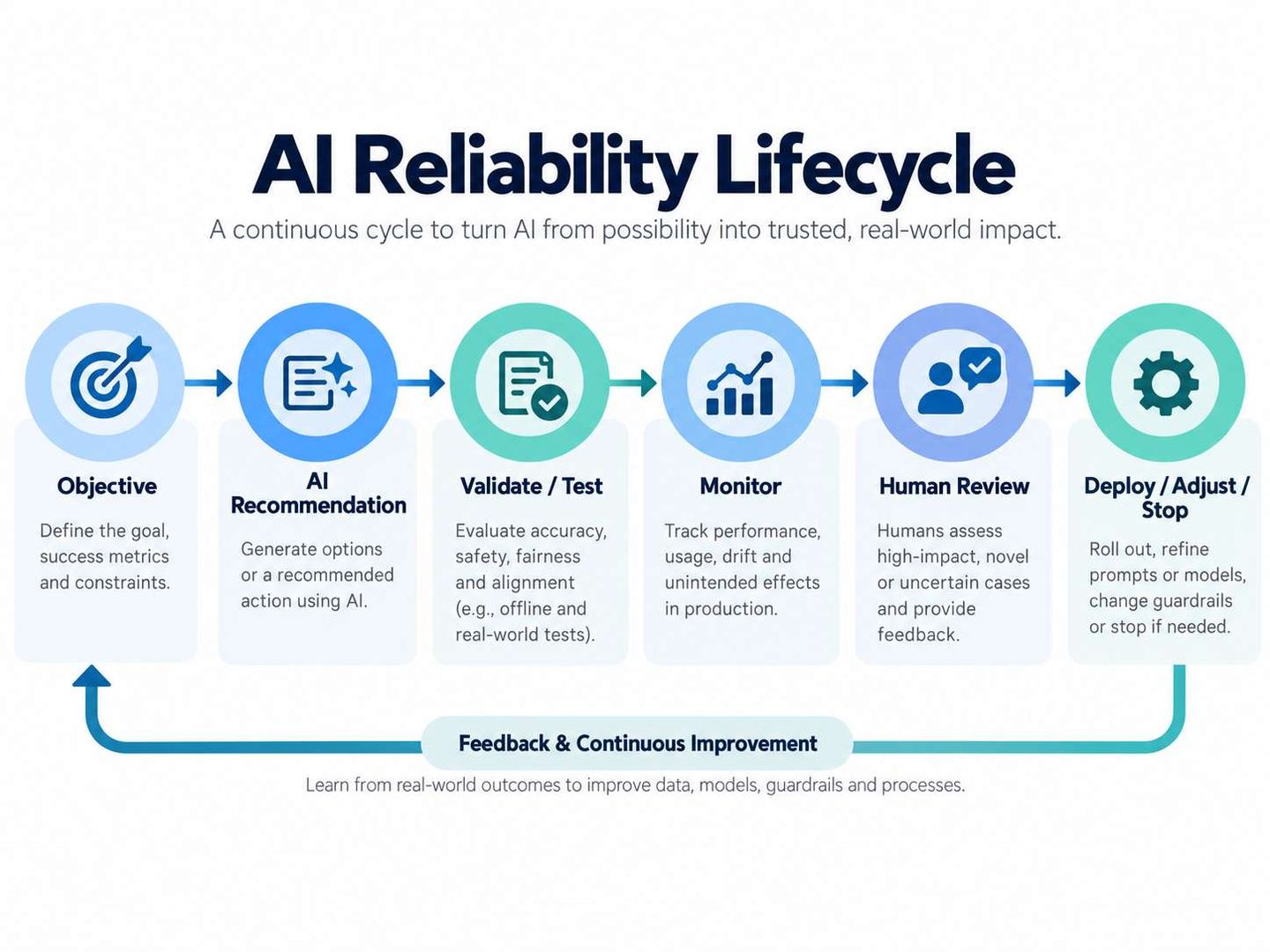
Muppala argues that deployment should not mark the end of evaluation but the beginning of continuous measurement. AI-assisted systems operate in environments that change: data distributions shift, user behavior evolves, adversaries adapt, business objectives change, and models themselves may be updated. A reliability-oriented lifecycle therefore begins by defining the objective and appropriate success criteria, continues through AI-assisted recommendations and validation, and extends into ongoing monitoring and human review. The result is not a one-time approval process but a feedback loop in which real-world outcomes inform future models, experiments, safeguards, and decisions.
Research and Frameworks Informed by Practice
Muppala has translated many of these operational questions into independent research. In Why AI Cannot Replace Business Intelligence, A/B Testing, and Human-Driven Insights Across Industries, he examines why AI output and validated decision-making are not equivalent. Artificial intelligence can process large amounts of information and identify patterns rapidly, but experiment design, contextual interpretation, validation, traceability, and consequential judgment still require human involvement.
He later developed those ideas in Integrating Human Oversight with AI-Based Planning Systems: A Framework for Ethical Business Intelligence and Adaptive Experimentation in Nationally Critical Sectors. That research proposes an architecture connecting AI planning models, experimentation and validation loops, observable business-intelligence or monitoring interfaces, and human-in-the-loop governance. The objective is not simply to place a person at the end of an automated process. Meaningful oversight requires giving people the evidence, visibility, and authority necessary to understand an AI-assisted recommendation, challenge it, and intervene when necessary.
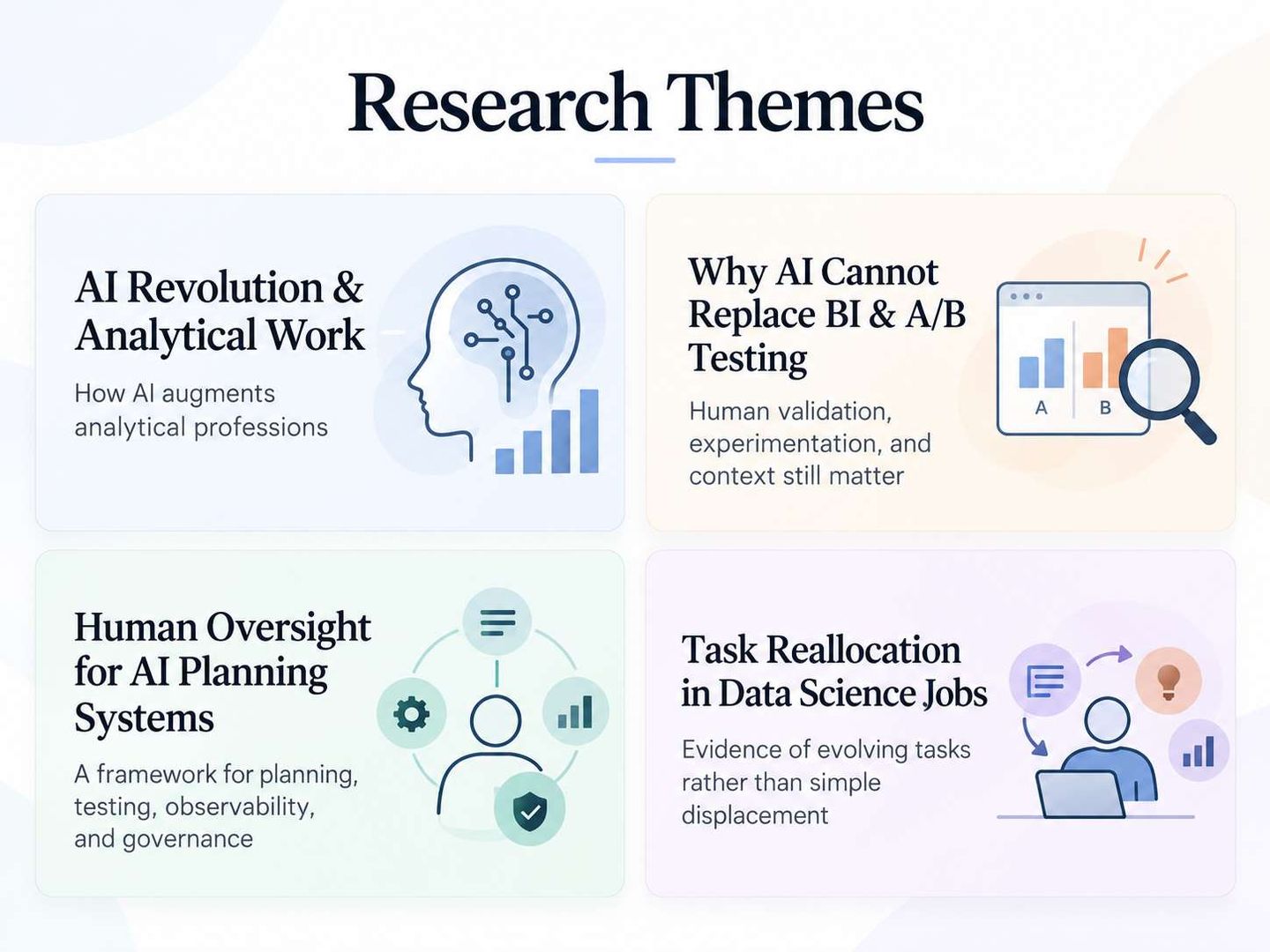
Muppala has also studied the changing relationship between AI and analytical work. In From Job Displacement to Task Reallocation: Evidence from Temporal Analysis of Data Science Job Postings, he compared a historical baseline with 58,830 U.S.-based Data Scientist postings from 2023. The study was descriptive rather than causal. Its results documented changes in the relative emphasis of skills and responsibilities and were more consistent with task reallocation than with a simple disappearance of analytical work. The findings point toward a growing importance of modern production workflows, integration, monitoring, and orchestration alongside foundational analytical skills.
Serving as a judge and reviewer has reinforced Muppala’s perspective that rigorous methodology, transparent assumptions, and evidence that supports conclusions matter more than surface-level sophistication. He applies that same discipline to how AI-assisted systems should be evaluated.
Policy Context and Independent Alignment
Recent U.S. technology policy provides independent context for many of these questions. The White House's 2026 National Security Science and Technology Strategy identifies artificial intelligence and autonomy and information management and cybersecurity among critical and emerging technology areas. Within AI and autonomy, it highlights planning, reasoning and decision-making, interpretability and control, and adversarial robustness and AI security. The strategy separately identifies information management and cybersecurity topics such as AI-enabled cyber capabilities, digital identity technologies and biometrics, data security, and communications and network security.
NIST's Artificial Intelligence Risk Management Framework provides another useful connection. It describes trustworthy AI in terms that include validity and reliability, security and resilience, accountability and transparency, and explainability and interpretability. It treats risk management as a lifecycle responsibility rather than something completed once before deployment. These documents do not imply government sponsorship or endorsement of Muppala's individual work. Their significance is that they independently identify many of the same technical problem areas that have emerged throughout his career and research.
A Portable Approach and What Comes Next
Muppala’s stated goal is to continue developing reusable approaches to analytical validation, experimentation, monitoring, security, and human governance that can be adapted across high-impact environments in the United States. He emphasizes that responsible validation and rapid innovation are not opposites; better testing, measurement, and monitoring can help organizations adopt AI with greater confidence.
That could mean clearer definitions of success before an automated system is deployed, stronger integration of experimental thinking into AI-assisted decisions, observability that measures real-world outcomes rather than model performance alone, earlier detection of systemic failure modes, and governance structures that preserve meaningful human accountability. Financial systems, large technology platforms, account security, and other high-impact environments may involve very different applications, but they repeatedly raise related questions: What is the system optimizing? How was the intervention validated? Which errors matter most? How quickly can performance changes be detected? What evidence should trigger human review? Who ultimately owns the decision?
Muppala plans to continue examining those questions through a combination of industry practice, independent research and publication, judging, reviewing, and interdisciplinary collaboration. His objective is not to slow down AI adoption. It is to help make adoption more dependable by improving how AI-assisted systems are tested, validated, monitored, secured, and governed.